Why Carbohydrates Are Essential to Your Indian Kitchen
Learn to build a balanced, energy-sustaining Indian plate by incorporating a variety of traditional whole grains and diverse food groups.
 By IDYORA Nutrition Desk 29 Sept 2026 5 min read
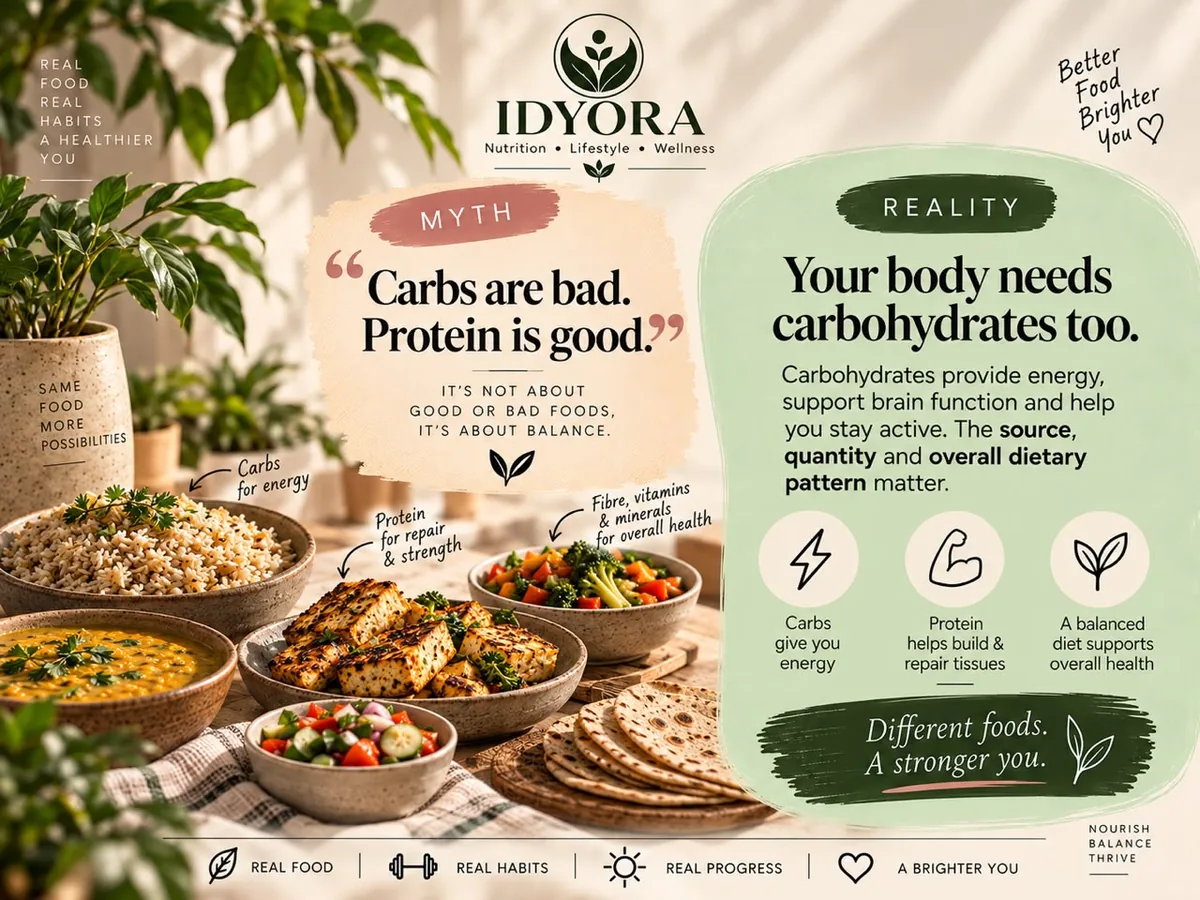
Carbohydrates are the primary fuel source for your body, providing the energy needed for everything from daily chores to your fitness goals. By choosing diverse, whole-grain staples like millets, brown rice, and legumes instead of refined options, you can easily build a sustainable, energy-packed plate. Try swapping one serving of white rice for quinoa or millets this week, and pair your rotis with plenty of dal and seasonal sabzis to create a balanced, nutrient-dense meal.
The Truth About Carbohydrates
In recent years, carbohydrates have often been unfairly labeled as the enemy of wellness. However, in the context of an Indian kitchen, they are a fundamental part of a balanced diet. The issue is not the presence of carbohydrates themselves, but the shift in our dietary habits. Traditional Indian practices of season-specific, diverse food intake are fading away, and populations across India now source their nutrients from fewer food groups than recommended1.
Modern dietary trends often encourage the elimination of staples, but the ICMR-National Institute of Nutrition (ICMR-NIN) emphasizes that a healthy, balanced diet should provide the required calories, proteins, vitamins, minerals, and adequate fiber to support overall health2. Rather than fearing carbohydrates, the focus should be on the quality and diversity of the foods we consume.
Understanding Energy: Why Your Body Needs Carbs
Carbohydrates, along with fats and proteins, are "macronutrients" that your body requires in large amounts to maintain physiological and biochemical processes2. They serve as the primary fuel for your daily activity and performance. For Indian adults who are physically active, carbohydrates should ideally make up 50–60% of total daily calories to support energy levels and recovery3.
It is important to remember that dietary requirements vary based on age, gender, physiological status, and physical activity2. Consuming too little or too much can have consequences, which is why a balanced approach is essential2. When you view carbohydrates as a source of sustained energy rather than a dietary "villain," you can better appreciate their role in helping you stay active and nourished throughout the day.
The Role of Whole Grains in Traditional Indian Meals
Refined carbohydrates, such as white rice and white flour, have become the mainstay of the modern Indian diet, which may contribute to the rising incidence of type 2 diabetes and cardiovascular disease4. Prior to the 1950s, whole grains such as amaranth, barley, brown rice, millet, and sorghum were more commonly used in Asian Indian cooking4.
"Many studies have shown the benefits of lower carbohydrate and higher protein diets, including greater satiety, weight loss, and improvements in cholesterol and insulin parameters4."
However, simply switching to a whole grain does not automatically mean a food has a low glycaemic index (GI). Research indicates that the method of processing, the structural integrity of the food, and how it is prepared all influence the glycaemic response5. For example, while some millet-based preparations may fall into a higher GI category, you can favorably modify the overall glycaemic response of a meal by including low-GI legumes as accompaniments5.
Balancing Your Plate: Integrating Carbs, Protein, and Fiber
The ICMR-NIN has developed a "My Plate for the Day" model to encourage dietary diversity1. To ensure you are getting a proper balance of macro and micronutrients, your plate should ideally source nutrients from a minimum of 8 to 10 food groups per day1.
A healthy, balanced plate should be structured as follows: - Vegetables and Fruits: These should essentially form half of your plate per day, including a variety of green leafy vegetables, tubers, and roots1. - Cereals and Millets: These should occupy a major portion of the plate, with a balanced diet providing no more than 45% of calories from cereals and millets2. - Pulses and Legumes: These are essential for protein and fiber and should be included alongside your grains1,2. - Nuts, Seeds, and Curd: These provide essential nutrients and are part of a balanced diet1,2.
For good health, nutrients must be sourced from a minimum of 8 to 10 food groups in a day, as many people currently source their nutrients from not more than 4 to 5 food groups1.
Practical Tips for Daily Balanced Eating
Building a balanced Indian meal is simpler than it seems. Start by diversifying your staples. If you are used to white rice, consider mixing in brown rice, quinoa, or millets, as these are nutritionally advantageous carbohydrate substitutes4.
- Smart Snacking: Instead of reaching for processed snacks, try vegetable or fruit salads topped with seeds or nuts, or enjoy roasted chickpeas, lobia, or peanuts2.
- Pre-workout Fuel: If you are exercising, aim for a meal that is high in carbohydrates and moderate in protein3. A paneer wrap made with a whole-grain roti is a great example of a balanced pre-workout option3.
- Post-workout Recovery: Focus on protein-rich foods with a moderate amount of carbohydrates to aid in recovery3.
- Cooking Methods: Use minimal oil, ghee, or butter, and keep salt intake to a minimum2,6. Opt for steaming, boiling, or roasting whenever possible to preserve the integrity of your ingredients6,5.
Consulting Professionals for Personalized Nutrition
While these guidelines provide a framework for a healthy lifestyle, individual needs are unique. Your specific requirements for macronutrients—carbohydrates, proteins, and fats—will depend on your personal health history, age, and activity level2.
If you are living with a specific health condition or are looking to make significant changes to your diet to manage your wellness, please plan these changes with your doctor or a registered dietitian. They can help you create a personalized plan that honors your cultural food preferences while ensuring your body gets the specific nutrients it needs to thrive. Professional guidance ensures that your journey toward better health is safe, sustainable, and tailored specifically to you.
Sources
6
- s Promotion of “My Plate for the Day” and physical activity among the population to prevent all forms of malnutrition and NCDs in the countryICMR-National Institute of Nutrition
- DIETARY GUIDELINES FOR INDIANSICMR-National Institute of Nutrition
- Optimized Diet Plans for Indian Adults Engaged in Regular Exerciseexa.ai, 2025
- Incorporation of Whole, Ancient Grains into a Modern Asian Indian Diet: Practical Strategies to Reduce the Burden of Chronic DiseaseUS National Institutes of Health, 2011
- Carbohydrate profiling & glycaemic indices of selected traditional Indian foodsUS National Institutes of Health, 2022
- Food-based dietary guidelines - IndiaFAO