Raw or Cooked Weight? Why Roti and Rice Numbers Differ
Understanding how cooking affects the weight of your food is key to consistent kitchen habits. Learn why your rice portions change and how to track them.
 By IDYORA Guides Desk 12 Oct 2026 5 min read
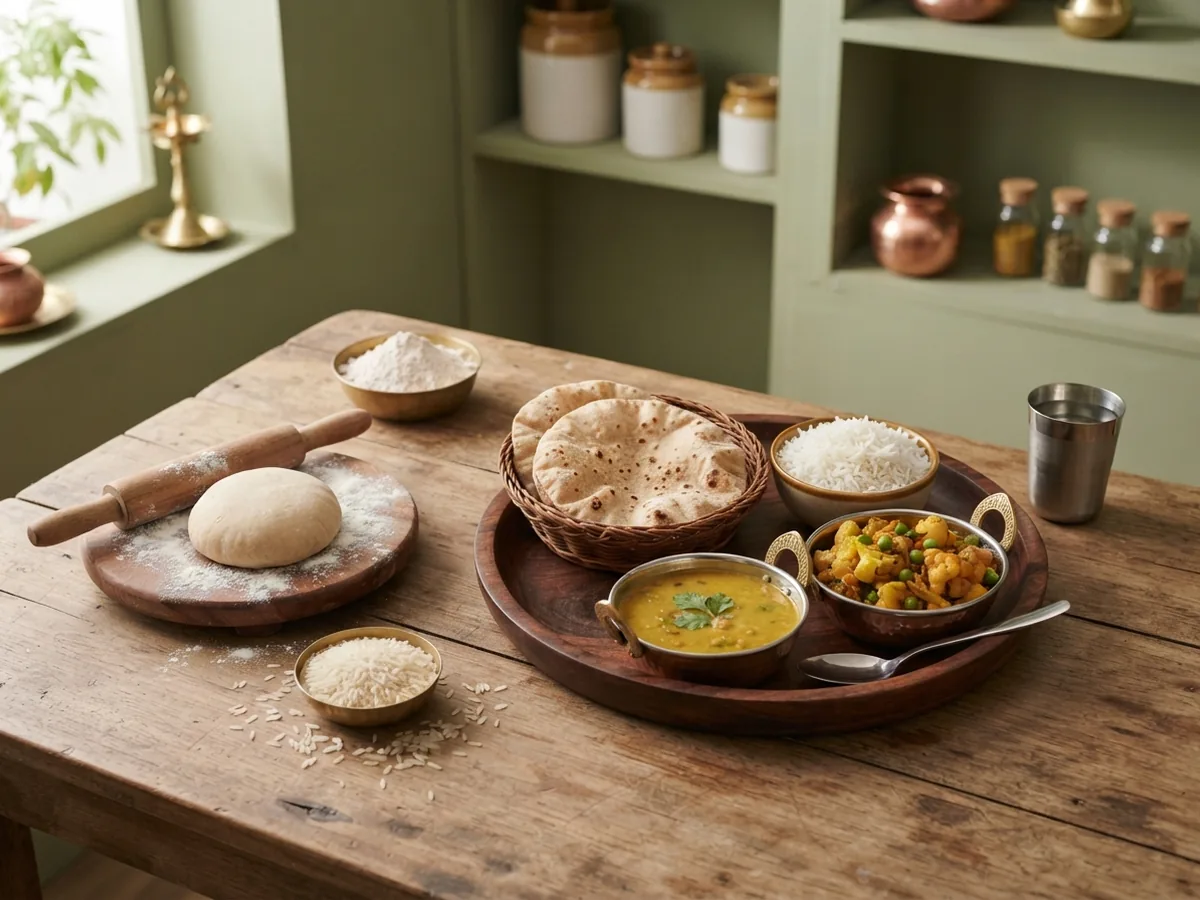
Understanding how cooking affects the weight of your food is the secret to consistent kitchen habits. Because ingredients like rice and dal absorb water during the cooking process, their weight changes significantly, meaning that a 100g portion of raw rice will look and weigh very different once it is boiled and ready to serve1. To keep your kitchen measurements reliable, decide on one method—weighing your food raw or weighing it cooked—and stick to it consistently for your daily meals.
The Science of Weight Change During Cooking
In an Indian kitchen, we transform raw ingredients into nourishing meals through various methods like boiling, pressure cooking, and steaming. When you cook grains, pulses, or even vegetables, the primary physical change is the absorption of water.
For example, research shows that when you cook rice, the grain absorbs water, which significantly increases its weight compared to its dry, raw state1. Depending on the variety and the cooking method, 100g of raw rice can result in a cooked weight that varies widely1. Rice has higher moisture content which acts as an energy diluent, decreasing the total starch in equivalent quantities2.
Why Raw and Cooked Numbers Don't Match
A common point of confusion arises when comparing "per 100g" figures from different sources. If you look at a database entry for raw long-grain white rice, it is listed at 365 kcal per 100g, while cooked long-grain white rice is listed at 130 kcal per 100g [USDA FoodData Central]. This difference exists simply because the cooked version contains nearly 68g of water per 100g, compared to only about 11g in the raw version [USDA FoodData Central].
If you weigh your rice after it is cooked but apply a "raw" calorie number to it, you will significantly overcount your portion. Conversely, if you weigh your raw rice but use a "cooked" calorie number, you will undercount it. Polishing significantly reduces the nutrient content of rice, including fat, dietary fibre, ash, and various vitamins, by between 30 and 90%1.
Understanding Database Variations
When you search for nutritional information, you might find conflicting numbers for the same dish. This is often because different databases calculate values in different ways. Some databases build recipe values by summing the nutrients of all raw ingredients and dividing by the total weight, while others analyze cooked samples directly [Vijayakumar et al., 2024].
"Analysing cooked samples would be more accurate than calculating from raw ingredients but is costly." — Vijayakumar A, et al., 2024.
Furthermore, many databases have not yet applied a "yield factor," which is the scientific term for the correction needed to account for the weight lost or gained during cooking [Vijayakumar et al., 2024]. Because of these variations, it is best to look for a source that explicitly states whether the weight basis is "raw," "dry," "uncooked," or "cooked" rather than trying to average numbers from different places.
Choosing Your Consistent Kitchen Habit
To maintain consistency, you do not need to worry about which database is "correct." Instead, focus on your own process:
- Pick one habit: Decide if you prefer to weigh your ingredients raw or cooked. If you are preparing a meal for the whole family, weighing the raw ingredients (like the total amount of atta or rice) before cooking is often the most practical approach.
- Check the label or source: Whenever you use a reference for your portions, check if the figure provided is for the raw or cooked state.
- Account for additions: Remember that figures for plain grains or rotis do not include the ghee or oil you might add later. Always track these fats separately, as they are not part of the base weight of the cooked grain or bread.
- For rotis: Since the water content in a roti can vary based on how long it is cooked, it is often more accurate to count the weight of the raw atta that went into the dough or use a specific per-roti figure if you know the weight of the dough ball [USDA FoodData Central].
Tips for Accurate Home Cooking Measurements
Consistency is the most important factor in your kitchen. If you are living with a condition and are managing your diet, it is always a good idea to plan any significant changes with your doctor or a registered dietitian.
- Standardize your rice cooking: Research indicates that the water-to-rice ratio significantly impacts the final weight of your meal1. For instance, studies have standardized ratios like 1:2.0 for brown rice and 1:2.8 for polished rice to determine cooked weight1.
- Be mindful of preparation: Remember that washing your rice before cooking can lead to a loss of certain nutrients like thiamin and niacin3. While this is a standard part of Indian home cooking, it is another reason why calculations based on raw ingredients are estimates.
- Use the same scale: If you use a kitchen scale, keep it in one place and use it for your raw ingredients before they hit the pot. This eliminates the guesswork of how much water was absorbed during the boiling process.
By focusing on the weight of the ingredients as they enter your kitchen—or consistently weighing your portions on the plate—you can build a reliable routine that supports your balanced diet without the stress of conflicting numbers.