Nourish Your Natural Glow: Everyday Foods to Support Collagen Production
Discover how simple, everyday ingredients found in your kitchen can support your body's natural collagen production as part of a balanced diet.
 By IDYORA Nutrition Desk 8 Oct 2026 6 min read
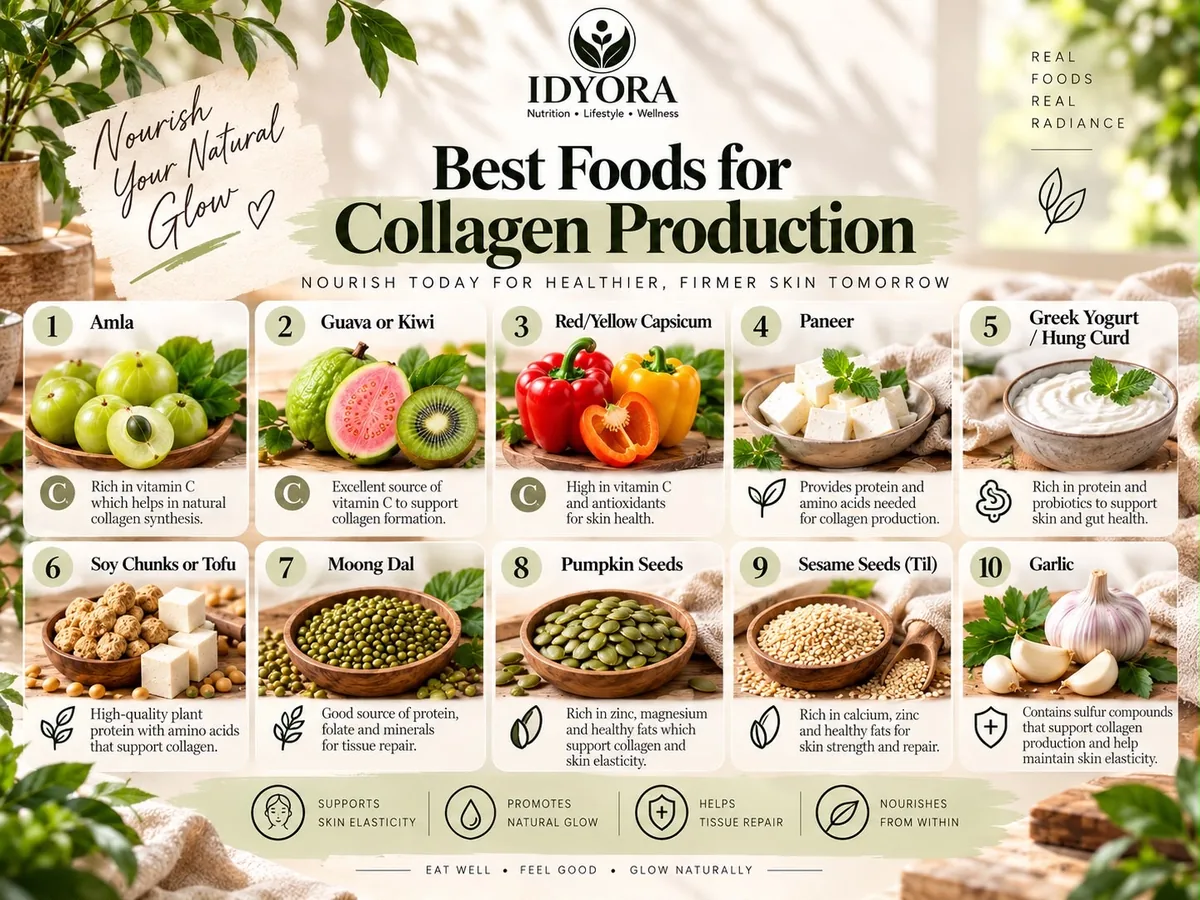
Supporting your body’s natural collagen production is less about expensive serums and more about the nourishing meals you prepare in your own kitchen. By incorporating protein-rich dals, seasonal vegetables, and vitamin C-packed fruits into your daily routine, you can enjoy a wholesome and balanced diet. Try adding a squeeze of fresh lemon to your dal, snacking on a handful of nuts, or including a generous portion of leafy greens in your lunch this week.
Understanding the Basics of Collagen
Collagen is a fundamental protein in our bodies, acting as a structural component for various tissues. When we eat protein-rich foods, our digestive system breaks them down into amino acids, which the body then distributes wherever it is most needed1. While there is a lack of research to show that eating collagen directly benefits skin or joint health, consuming foods that support its natural production is a recommended part of a healthful eating plan1.
Collagen biosynthesis relies on a complex process involving both macronutrients and micronutrients. The body requires specific amino acids—namely glycine, proline, and hydroxyproline—to form these proteins1. Additionally, the process is influenced by the cellular redox state, which requires minerals and bioactive chemicals like iron and copper2. Collagen accounts for approximately 25-30 percent of the overall total protein composition within the human body2. If you are managing a specific health condition, please plan any significant dietary changes with your doctor or a registered dietitian.
Vitamin C Rich Foods for Synthesis
Vitamin C is a critical cofactor in the production of collagen, as it helps stabilize the tertiary structure of collagen molecules2. Ascorbate (vitamin C) and iron act as cofactors for the proline and lysine hydroxylases that stabilize the tertiary structure of collagen molecules2. Fortunately, the Indian kitchen is naturally stocked with incredible sources of this vital nutrient.
According to the ICMR-NIN, a balanced plate should be half-filled with fruits and vegetables3. For a vitamin C boost, look toward:
- Amla (Indian Gooseberry): Amla is a source of vitamin C3,4.
- Citrus fruits: Lemons, oranges, and tangerines are excellent sources that can be easily incorporated into daily meals3,4.
- Guava: This fruit is a source of vitamin C3,4.
- Papaya: A versatile fruit that is a source of vitamin C3,4.
- Bell Peppers (Capsicum): Whether green, yellow, or red, these are rich in vitamin C and antioxidants3,4.
"Collagen production requires both micronutrients and macronutrients. Collagen fibers are made from fibroblasts... Lysine, a macronutrient, is highlighted with vitamin C, copper, and iron, all of which are micronutrients"2.
Protein-Packed Staples for Amino Acid Support
To support your overall health, your body needs a steady supply of high-quality protein. Glycine, proline, and lysine are constituents of the primary structure of collagen2. Legumes, such as common beans (Phaseolus vulgaris L.), are particularly valuable as they provide lysine, which plays a critical role in the process of post-translational modifications facilitated with enzymes lysyl hydroxylase and lysyl oxidase2.
The ICMR-NIN suggests that a quarter of your plate should consist of protein-rich foods3. You can easily meet this through: - Pulses and Legumes: Dals, rajma, chana, and moong are staples that provide protein, minerals, and other nutrients2,3. - Dairy: Milk, curd, and paneer are recommended as part of a balanced diet3. - Nuts and Seeds: These provide protein and minerals3. - Eggs and Poultry: These are widely recognized as high-protein foods that contain the amino acids necessary for collagen production1.
Essential Minerals and Healthy Fats
Beyond protein and vitamin C, other micronutrients act as essential cofactors in collagen biosynthesis2. Iron and copper, for instance, are directly involved in the enzymes that stabilize collagen molecules2.
- Iron: Found in legumes, nuts, seeds, and leafy greens, iron works alongside vitamin C to support the proline and lysine hydroxylases that stabilize collagen2.
- Zinc: This mineral is essential for various metabolic processes and is found in legumes, nuts, seeds, and whole grains1.
- Healthy Fats: While the ICMR-NIN recommends keeping total fat intake to no more than 30 grams per person per day, moderate amounts of healthy fats are part of a balanced diet3. Prefer using a variety of oils to ensure you get a broad spectrum of nutrients3.
Practical Tips for Your Kitchen
Nourishing your glow is about consistency and choosing fresh, seasonal ingredients. The ICMR-NIN advocates for "My Plate for the Day," which emphasizes a balanced intake of four food groups3.
- Prioritize Freshness: Aim for 450 to 500 grams of fresh fruits and vegetables per day, drawing from what is locally available and seasonal3.
- Choose Whole Grains: Opt for whole grains over refined versions to ensure you are getting the full range of micronutrients3.
- Mindful Cooking: Avoid highly processed foods, which are often high in salt, sugar, and unhealthy fats while being poor in nutrients3.
- Simplicity: You do not need complex recipes. Adding a side of steamed greens, a bowl of dal, or a piece of seasonal fruit to your lunch makes a significant difference in your daily nutrient intake3.
Delicious Ways to Eat for Your Glow
Integrating these foods into your Indian home cooking is simple and satisfying. Here are a few ways to bring these principles to your table:
- Morning Ritual: Start your day with a glass of warm water and a squeeze of fresh lemon, or include a portion of papaya in your breakfast4.
- The Balanced Lunch: Ensure your plate is colorful. A serving of dal (protein), a generous portion of seasonal sabzi (leafy greens or other vegetables), a small bowl of curd (dairy), and a serving of whole-grain roti creates a perfect, balanced meal3.
- Smart Snacking: Instead of processed snacks, reach for a handful of nuts or a seasonal fruit like guava or an orange3,4.
- Flavorful Additions: Use condiments and spices to enhance the flavor of your meals without relying on excess salt or sugar3.
By focusing on a balanced, whole-food diet, you provide your body with the tools it needs to maintain its natural health and vitality. Remember, the best approach is to enjoy a variety of seasonal, home-cooked foods every single day.
Sources
4
- Collagen • The Nutrition SourceHarvard T.H. Chan School of Public Health, 2021
- Common Beans as a Source of Amino Acids and Cofactors for Collagen Biosynthesis - PubMedUS National Institutes of Health
- NUTRITION,ICMR-National Institute of Nutrition
- FSSAI Recommends 6 Foods Rich InFSSAI