Why You Should Fix Your Plate: A Simple Guide to Balanced Eating
Discover how simple, everyday food combinations can support your overall well-being. Learn how to build a balanced plate using your kitchen staples.
 By IDYORA Nutrition Desk 2 Oct 2026 5 min read
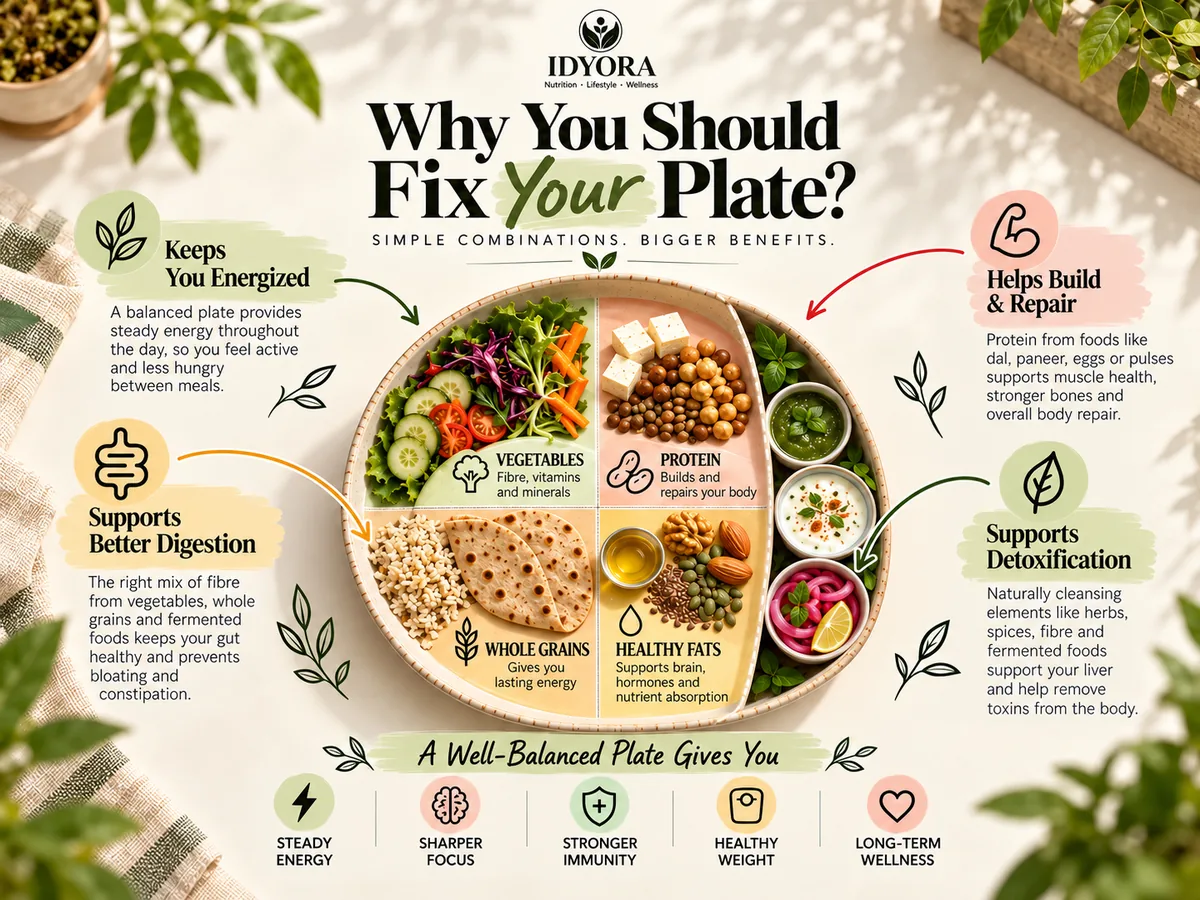
A balanced plate is simply a way of organizing your everyday meals to ensure you get the right variety of nutrients to feel your best. By focusing on simple swaps—like choosing a bowl of dal with brown rice instead of white, or adding a generous portion of seasonal sabzi to your plate—you can easily support your energy levels and overall well-being. To get started this week, try filling half your plate with vegetables at lunch, swapping one refined grain for a whole grain, and keeping a water bottle handy to stay hydrated throughout the day.
The Philosophy of a Balanced Plate
At its core, a healthy diet is built on the principles of adequacy, balance, moderation, and diversity1. Rather than focusing on strict rules or counting every morsel, the philosophy of a balanced plate encourages you to look at your meal as a whole. Experts suggest that a healthy plate should be composed of a variety of minimally processed, whole foods1.
When you sit down to eat, think of your plate in sections. Aim to fill half of your plate with vegetables and fruits, a quarter with whole grains, and a quarter with healthy protein sources2. The Healthy Eating Plate does not define a certain number of calories or servings per day from each food group; the relative section sizes suggest approximate relative proportions2. It’s a good idea to try to get this balance right every day, but you don’t need to do it at every meal3.
"The best diet to follow is one that is science based, that allows you to meet your nutritional requirements, and that you can stick to in the long run4."
Why Your Body Needs Vegetables and Whole Grains
Vegetables and whole grains are the foundation of an energized body. The Harvard T.H. Chan School of Public Health emphasizes that vegetables and fruits should make up half of your plate2. When choosing vegetables, try to include a colorful variety, though keep in mind that potatoes do not count toward this portion because they contain rapidly digested starch that impacts blood sugar similarly to refined grains2,5.
Whole grains—such as brown rice, oats, millet, and whole wheat—are essential because they are "intact" grains that have a milder effect on your blood sugar and insulin levels compared to refined grains like white rice or white bread2. Refined grains act much like sugar in the body, and consuming them in excess may make it harder to manage your weight and may increase the risk of heart disease5. By choosing whole grains, you are also consuming more fiber, which is vital for your health3. Everyone over the age of 10 should aim for at least 25 grams of dietary fiber daily1.
The Role of Protein and Healthy Fats in Daily Meals
Protein is a crucial building block for your body, and it should occupy about one-quarter of your plate2. Excellent sources include lentils (dal), chickpeas (chana), beans, peas, fish, and poultry2,1. These protein sources are versatile and pair well with vegetables2. It is wise to limit red meat and avoid processed meats like bacon or sausages, as regular consumption of these has been linked to an increased risk of heart disease and other health concerns5.
Healthy fats are also a necessary part of your diet, but the type of fat matters. The World Health Organization notes that a healthy diet should be low in unhealthy fats1. Instead of solid fats like butter or ghee, which are high in saturated fats, opt for liquid plant oils such as olive, sunflower, or peanut oil2,4. Liquid oils—such as canola, corn, olive, or peanut oil—have mostly unsaturated or polyunsaturated fats4. While it is important to include some fat in your diet, remember that "low-fat" labels do not automatically mean a product is healthy2.
Practical Tips for Daily Meal Planning
Planning your meals doesn't have to be complicated. Start by looking at what you already have in your kitchen. If you are preparing a traditional Indian meal like a chicken or paneer stir-fry with rice, you are already halfway there: the protein is the paneer or chicken, the rice is your starchy base, and the stir-fried vegetables provide the fiber and nutrients3.
- Prioritize variety: Include different types of foods from each group to ensure you get a wide range of nutrients1.
- Watch your drinks: Water, tea, and coffee (with little or no sugar) are the best choices6. Try to limit sugary drinks, as they provide little nutritional value2.
- Mind your portions: While you don't need to count calories, be aware of your portion sizes and limit your intake of free sugars to less than 10% of your total daily energy1,4.
- Small changes: If you have health concerns, such as diabetes or heart-related conditions, it is important to plan any significant dietary changes with your doctor or a registered dietitian4.
Simple Balanced Recipe Ideas
You can apply these principles to your everyday Indian home cooking with ease. Here are a few ways to rethink your plate:
- The Classic Thali: Instead of a large serving of white rice, serve a smaller portion of brown rice or a multigrain roti alongside a larger bowl of seasonal sabzi (like beans, cauliflower, or spinach) and a portion of dal or beans. This ensures you hit your vegetable and whole grain targets2,3.
- Wholesome Breakfasts: Swap refined flour (maida) snacks for oats-based porridge or a vegetable-packed moong dal chilla. These provide sustained energy throughout the morning1.
- Smart Snacking: If you need a snack, choose a handful of nuts or a piece of fresh fruit instead of processed, sugary snacks2.
- Hydration: Keep a water bottle at your desk or in the kitchen. If you enjoy tea, try to limit the amount of sugar added to your cup6.
By making these small, gradual adjustments, you are not just eating—you are nourishing your body for the long term4. Remember, the goal is to create a pattern of eating that feels good, supports your energy, and celebrates the variety of wholesome ingredients available in your kitchen.
Sources
6
- Healthy dietWorld Health Organization
- Healthy Eating Plate • The Nutrition SourceHarvard T.H. Chan School of Public Health, 2012
- Your guide to the eatwell plate - helping you eat a healthier dietFAO
- Plan Your Plate | NIH News in HealthUS National Institutes of Health, 2018
- Healthy Eating Plate vs. USDA's MyPlate • The Nutrition SourceHarvard T.H. Chan School of Public Health
- HealthyPlate_9.9.11_withCopyrightHarvard T.H. Chan School of Public Health