Beyond the Bowl: How to Make the Most of Your Plant-Based Iron
Learn how to pair plant-based iron sources with vitamin C-rich foods to support your body's nutrient absorption in your everyday Indian home cooking.
 By IDYORA Nutrition Desk 2 Oct 2026 5 min read
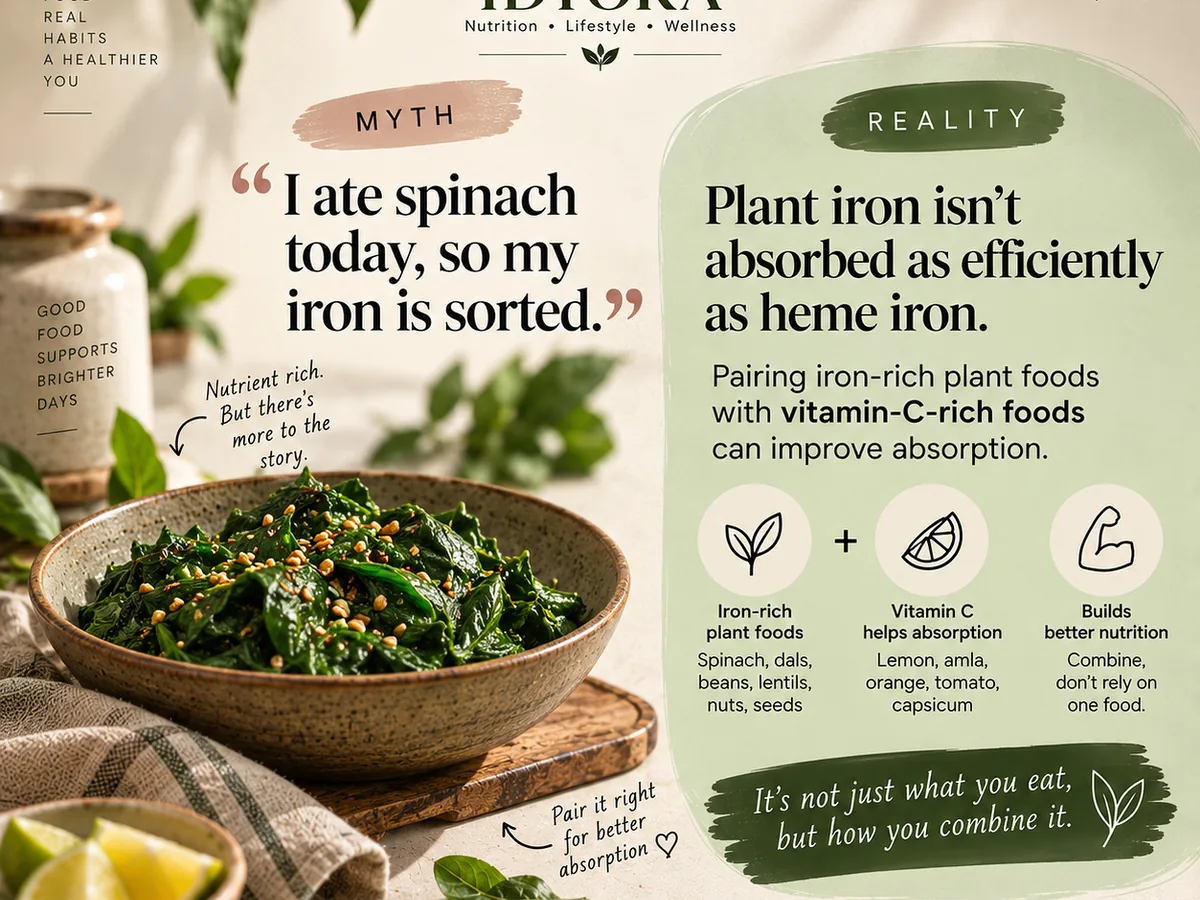
Getting the most out of your plant-based meals is less about tracking every milligram and more about how you build your plate. Your body absorbs iron from plant sources better when you eat it with foods that contain vitamin C1. Try these simple shifts this week: add a splash of lemon juice to your dal, serve a fresh kachumber salad with your roti, or enjoy a glass of homemade lemonade with your lunch.
The Truth About Plant-Based Iron
Iron is a vital mineral that your body needs to support growth and transport oxygen through your blood1,2. When we talk about iron in food, we generally categorize it into two types: heme and nonheme1,3. Heme iron is found in animal products like meat, poultry, and seafood, while nonheme iron is the form found in plant-based foods such as lentils, beans, spinach, peas, and fortified grains1,3.
For those following a vegetarian lifestyle, it is important to note that the body does not absorb nonheme iron as efficiently as heme iron1,3. Because of this, the US National Institutes of Health notes that vegetarians who do not consume meat, poultry, or seafood may need to aim for higher intakes of iron-rich foods to meet their needs1. If you are managing a specific health condition or have concerns about your intake, please plan any significant dietary changes with your doctor or a registered dietitian.
Why Pairing Matters: The Vitamin C Connection
Because nonheme iron is more sensitive to its environment, the company it keeps on your plate matters. Certain food combinations can either help or hinder how much iron your body is able to take up2.
Your body absorbs iron from plant sources better when you eat it with foods that contain vitamin C, such as citrus fruits, tomatoes, sweet peppers, and broccoli1,3,2. Vitamin C increases iron absorption2,3. Research on North Indian meal patterns found that adding 120 grams of orange or 250 milliliters of lemonade to rice-based meals with dal or saag enhanced iron bioaccessibility4.
Conversely, some substances can act as inhibitors. Tannins (e.g. in tea) and phytates (e.g. in cereals) reduce iron uptake2,3. The same study on Indian meal patterns noted that tea could reduce iron bioaccessibility4. If you enjoy your chai with a meal, you might consider shifting your tea time to an hour before or after your food to allow your body to focus on nutrient absorption.
Smart Combinations for Your Daily Meals
Building an iron-conscious plate doesn't require complicated recipes; it’s about simple, everyday kitchen wisdom. Since legumes, leafy greens, and whole grains are the cornerstones of the Indian diet, you have a wealth of options at your fingertips.
- The Lemonade Advantage: As noted in research, a glass of lemonade (250 ml) can increase the bioaccessibility of iron in rice-based meals with dal or saag4.
- Salad Pairings: Adding a fresh salad—rich in tomatoes, peppers, or citrus—provides vitamin C, which helps the body absorb iron from plant sources1.
- Fortified Staples: Many commercially available breads and cereals are fortified with iron1,3. Checking labels can help you identify these as part of a balanced diet.
- Variety is Key: Iron is found naturally in many foods, including nuts, seeds, and dark chocolate (at least 45% cocoa)1,3.
"The increase [in iron intake] should be coupled with efforts to combine appropriate foods in the diet to enhance the bioaccessibility of iron and reduce inhibitory factors4."
Simple Kitchen Tips for Better Absorption
There is a long-standing belief that the oxalic acid in certain greens, like spinach, prevents iron absorption. However, a study comparing kale and spinach found that oxalic acid did not significantly influence nonheme iron absorption in humans, suggesting that its role in iron nutrition is of minor relevance5. This means you can continue to enjoy your favorite leafy greens without worry.
When preparing your meals, keep these practical tips in mind:
- Cook with Vitamin C: If you are making a palak or methi dish, finish it with a generous squeeze of fresh lemon juice just before serving.
- Mind the Tea and Coffee: These beverages contain substances that may reduce iron uptake2.
- Balanced Plate: Aim to include a variety of iron sources, such as beans, lentils, and nuts, throughout the day rather than relying on a single food1,2.
The Importance of a Varied Diet
While focusing on specific pairings is helpful, the foundation of good health is a varied, balanced diet1,2. Foods contain a complex matrix of vitamins, minerals, and dietary fiber that work together to support overall wellbeing1.
If you suspect you are not getting enough iron or are experiencing symptoms like persistent tiredness, it is important to consult with a doctor2. They may check your blood levels and, if necessary, discuss the use of iron supplements3. It is important to note that supplements should be managed under medical supervision, as high doses can lead to digestive discomfort3.
By focusing on whole, plant-based foods and using simple, science-backed pairings, you can feel confident that you are doing the best for your body. Remember, small, consistent changes—like swapping a post-meal tea for a glass of lime water or adding a fresh tomato salad to your lunch—are the most sustainable ways to support your nutrition journey.
Sources
5
- Iron - ConsumerUS National Institutes of Health
- In brief: How can you get enough iron? - InformedHealth.org - NCBI BookshelfUS National Institutes of Health, 2023
- Iron • The Nutrition SourceHarvard T.H. Chan School of Public Health, 2019
- Effect of inclusion of key foods on in vitro iron bioaccessibility in composite mealsexa.ai, 2016
- Oxalic acid does not influence nonhaem iron absorption in humans: a comparison of kale and spinach meals | European Journal of Clinical NutritionNature, 2007